Jill Hogan
  • About Jill
  • Research
    • Publications
    • Lab
  • Teaching
    • Statement
  • For K-12 Teachers
  • Contact

Why bother with music education?

8/27/2014

1 Comment

 
A few months ago, I read this short NPR article  , which boasts that music should be taught for creativity over test scores.  

The NAfME spokesperson quoted in the article cites Broader Minded, which is NAfME's new advocacy tool that stresses a more "complete argument for music education", including sections about areas like improving collaboration and communication, as well as emphasis on grit and emotional intelligence, among others.  I'm excited at the potential of a perspective like that of Broader Minded for NAfME, as it is based in advocating the arts for their intrinsic qualities--things we already do in music classrooms--not on external, roundabout measures, like reading scores.  

While I am happy about the perspective of Broader Minded, I very much hope this is a stepping stone to more substantially-supported arguments and that it encourages future research.  Currently, each 21st-century skill or area of brain development cited is supported only by short narratives from music teachers, students, and parents.  While these are undoubtedly valuable, they do not provide a substantial, research-based argument.  In some cases, research does not exist--a great reason for more research on these cognitive habits.

I have to take some issue with the NPR article title's reference to creativity.  Nowhere in the article to we hear creative acts referenced--what we do hear about is children learning Wade in the Water by rote.  If we mentioned rote learning in any other subject, it would be labeled as the antithesis of creativity.  Yet by being musical, we somehow get a pass on using that word...

1 Comment

"The Arts Traffic in Subtleties."

2/13/2014

1 Comment

 
About a month ago, I learned through some Facebook postings about the death of Elliot Eisner.  

The first time I heard about Elliot Eisner was in graduate school, when I stumbled upon the Ten Things the Arts Teach, readily available on the NAEA website.  It has since made the rounds to parents in places where I taught music.  Every so often, when I feel like a lost puppy, tired and weary from education and teaching and unsure about my purpose, it gets pulled out for inspiration.  

I hope you have or will appreciate these points as much as I have and pull them out on those instances when you're thinking, "I do WHAT everyday, and why would that ever matter?"  One of my favorite quotes from the list is the one in this post title.  

Shortly after my initial discovery, I purchased The Arts and the Creation of the Mind, and I have to admit it has sat on my shelf for a long while, because, well, my reading list is rather long.  And I have a feeling that is a really unfortunate thing, so it's moved to the start of the list.  I'm excited to start it up after I finish Paul Bloom's latest book.  Does anyone want to read it with me at the same time?  I'm sure it would make for great discussion!
1 Comment

It Takes A Choir: Postponed

11/5/2013

2 Comments

 
There's been an awful lot of publicity on the USA network, but it looks like we won't be able to watch It Takes a Choir for a few more months. 
Picture
2 Comments

It Takes A Choir

10/21/2013

1 Comment

 
While glued to Law and Order: SVU marathons on USA, I've been noticing ads for It Takes A Choir, a new show airing in November.  

Will I watch this show?  Sure, I will.  I'm going to try it.  
Is it possible that the unrealistic expectations placed upon the "spellbinding power of music," and the be all-end all emphasis on the culminating public performance will drive me crazy and I'll stop?  Yes, entirely.

I have some concerns about what the episodes show (or don't show), about what aspects of the rehearsal process are emphasized, and the general tone the series could take.  I'll write about them after watching an episode or two, because maybe I'll be pleasantly surprised..  Will you be watching, also?
1 Comment

Boston Street Pianos

10/4/2013

1 Comment

 
I remember in 2010 when New York City hosted some street pianos.  Because I am a pessimist, I wasn't all that impressed.  The artist part of me knew there was something cool about making instruments accessible in public, and that the unexpected placement of those pianos would be whimsical and fun.  But a greater part of me was not all that excited.

This is because my gut reaction was not to envision the best.  I envisioned obnoxious high schoolers making a nonsensical racket, adults rudely using it as a flat space to rest their soda can, and small children plunking out Jingle Bells incessantly while I tried to read.  So I wasn't holding my breath for them to come to Boston. 

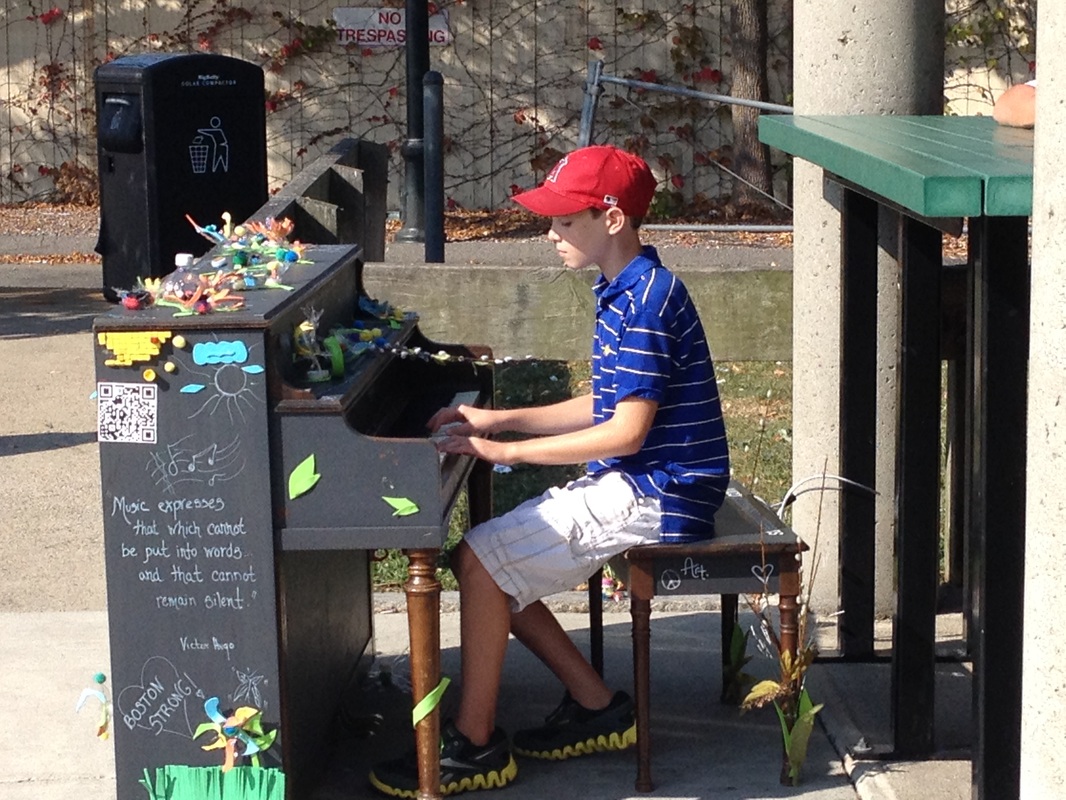
Recently, and lasting until mid-October, they arrived, and have been decorated by local artists.  Given that I'm out an about in Boston quite a bit, I've seen several, including the ones in Harvard Square Plaza, outside Sullivan's on Castle Island in South Boston, and near the Berklee Bookstore on Boylston Street. 

The pessimist in me has been squashed.  I have not witnessed any of the scenes above.  I've only witnessed delighted elderly men dusting off songs from long ago, children plunking out pieces of pop songs to happy audiences, and a presumably homeless woman smiling and improv'ing while her belongings sat nearby and a group of her friends listened.  

Picture
This young man serenaded a large audience at Castle Island on Wednesday.
People, perhaps, can be trusted more than I generally envision.
Music, perhaps, has a power to make people see only good possibilities.
This was, perhaps, a really great idea.
1 Comment

NYT Asks Students About Creativity in Schools

9/28/2013

1 Comment

 
There are many great things to think about in the responses to the questions the New York Times posed to students here.  Prompted by several questions about creativity in school, their personal lives, and society, students (and presumably some adults) responded in predictably varied ways.  

The first thing that struck me as I read through the responses was a good feeling that students (although most of them seemed to be from an arts-centered high school, perhaps to complete an assignment) were being forced to think about creativity, its place in the world, and to question its place in their school days.  What a great question for the increasingly bored student population to think about, and perhaps helped give some of them words to articulate part or all of what is missing from their day.

The second point that stuck out to me was the various definitions of being creative.  Nearly all responses clung to the traditional fine and performing arts to describe creativity, though the prompt mentioned scientific and technologic endeavors.  Use of the word "creativity" is a constant pet peeve for me, as anything in the artistic realm seems to be confused for a creative act.  Hand a kid a crayon, that's creative.  Let them run around how they want, and that's just like dance.  In the comments, students relate basketball, cheerleading, soccer, knitting, and computers to opportunities for creativity.  While I do not question the ability to infuse creativity into cheerleading (or any other) pedagogy, or to approach soccer playing creatively as a student, I do question them being labeled as creative, presumably just because they are enjoyable.  Creative does not equal enjoyable. 

Creativity also does not necessarily equal music or art class.  As Penny writes in comment 27, "Art, music and band, the only separate creative classes in elementary school, follow the guidelines of the projects the teachers provide. Art more so than music will allow a little creativity from the student as long as they follow the main instructions of the project. In Music class you sing what you are told and in Band you usually play what you are told. Only at home is where the band members are allowed to be creative."  Many superintendents, parents, and, as shown here, students, rest on their laurels by the offering of arts classes.  However, many ensemble settings or cookie-cutter art projects offer very little authentic, genuine opportunities for creative, inventive acts.   This disconnect between creativity and the arts is also evident to Shayla in comment 2, " the only creative outlets we were given were music and art, but we didn’t have any freedom in what we did. Everything in art was an assignment with a tight criteria. In music we only learned how to read music and play specific notes. That’s all we did all year long."

In the prompt, the NYT asks how they are inspired "to design, invent, and imagine new ideas."  I think this is a great definition of actively creating, and it spans all disciplines.  I (realizing the controversy of such a statement) don't find many arts education experiences necessarily creative by this definition, and perhaps that's okay for the sake of other skills.  But if so, it's important to embrace the spirit of the NYT "creativity" in all areas of schooling.  


1 Comment

STEM and STEAM

6/20/2013

0 Comments

 
I am an arts person.  
Definitively. 

So the STEM movement (science, technology, engineering, and math), when I first hear of it, made me do an imaginary eye roll.  While I find nothing wrong with these disciplines, indeed they are necessary, I find a further emphasis on black and white numbers (which must imply a deemphasis on ambiguous and grey humanities) to be another simplified solution to problems in education.  

My knowledge of STEM has expanded a bit since I first heard of it, and it is encouraged by articles like this.  Project-based learning based in engineering fields is certainly something my constructivist, student-centered self can support.  

I do have to wonder, however, if "these niche schools are built on project-based learning, critical thinking and collaboration," as the article states, why is this a construction from science, technology, engineering, and math?  Is this a function not of those disciplines, but just of good teaching?  Can we not employ those foci universally?  Furthermore, project-based learning, critical thinking, and collaboration are fundamentally present in the arts.  It is not something you can add in to arts teaching.  It IS arts teaching, in nearly all formats that arts teaching can take.  

If changing STEM to STEAM calls further attention to arts education, then fantastic.  But it seems to me that there is a much bigger message here, and we are just dressing up fundamental disciplines in a way that is sounds educationally fashionable today, speaking to the what and not the how.  
Share
0 Comments

    Archives

    October 2014
    August 2014
    February 2014
    November 2013
    October 2013
    September 2013
    June 2013

    Categories

    All
    Arts Advocacy
    Creativity
    Democratic Schooling
    Music
    Music Ed
    Tv

    RSS Feed

Proudly powered by Weebly